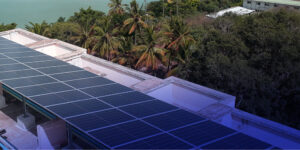


The 400-watt solar panel price in India ranges from ~₹9,000* to ₹17,200* per panel in 2026. Although these solar panels are still available, they are no longer a preferred choice for new residential rooftop solar installations.
*Please note prices are subject to change. The above-mentioned 400-watt solar panel prices are indicative and not fixed. They’re based on standard market research. The final 400-watt solar panel price in India can vary depending on panel type, brand, cell technology, market demand for the module, promotional offers provided by the manufacturer, availability, taxes, shipping, warranty, and order quantity, etc.
India’s solar industry has shifted towards higher-wattage TOPCon (Tunnel Oxide Passivated Contact) modules, which offer greater power output per panel.
According to Mercom India’s State of Solar PV (Photovoltaic) Manufacturing in India 2026 report, ~70% of India’s installed solar module manufacturing capacity was based on TOPCon technology at the end of 2025. Polycrystalline accounted for only ~2%.
This shift is also reflected in the higher-wattage home solar panels now available in India:
- Mono-PERC modules are now commonly available at around 530-550Wp (watt-peak).
- Current residential TOPCon panels extend from 560W (watts) to 600W and beyond.
So, where does a 400W panel still fit, why are we talking about it, and how much does it cost in 2026?
This guide covers the 400-watt solar panel price in India and explains its specifications, output, battery charging, real-world applications, and why it should not be selected for a new rooftop solar system in 2026.
What Is a 400-Watt Solar Panel?
A 400-watt solar panel is a photovoltaic module with a rated maximum power output (wattage) of 400Wp under Standard Test Conditions (STC). The 400W rating is the panel’s peak DC (direct current) power, rather than how much electricity it will produce continuously throughout the day.
STC measures a solar module at 1,000 W/m² solar irradiance, a cell temperature of 25°C, and an air mass of 1.5.
400W panels have been produced using different technologies over the years. This includes monocrystalline and mono-PERC modules, as well as some polycrystalline and bifacial models. However, module technology and wattage have progressed significantly beyond this class.
Does a 400-Watt Solar Panel Always Produce 400 Watts?
No. The 400W rating represents the panel’s maximum output under the laboratory conditions, as already explained above. In actual use, its output changes throughout the day and is usually lower than 400W.
The actual solar panel output is affected by factors such as:
- Solar irradiance
- Panel temperature
- Shading
- Dust and soiling
- Panel orientation and tilt
- Wiring and conversion losses
- Age and degradation of the module
Always remember that the panel’s rated wattage measures power, whereas the electricity generated over time is measured in watt-hours or kilowatt-hours.
How Much Does a 400-Watt Solar Panel Cost in India in 2026?
The 400-watt solar panel price in India in 2026 is currently around ~₹9,000* to ~₹17,200* per panel across the monocrystalline and mono-PERC products. Prices vary considerably because 400W modules are no longer mainstream, and availability differs between sellers. Also, these are standalone module prices, not the cost of an installed solar system.
*Please note prices are subject to change. The above-mentioned 400-watt solar panel prices are indicative and not fixed. They’re based on standard market research. The final 400-watt solar panel price in India can vary depending on panel type, brand, cell technology, market demand for the module, promotional offers provided by the manufacturer, etc. SolarSquare does not manufacture, sell, install, or endorse any 400-watt solar panel. We install rooftop solar panel systems for housing societies, homes, and commercial and industrial buildings using higher-wattage TOPCon and latest technology solar panels.
400-Watt Solar Panel Price in India by Technology
The following price range is based on currently listed 400W products and should be treated as indicative retail prices rather than final quotations.
| Panel Type | Indicative Price* | Availability in 2026 for Rooftop Solar |
| 400-watt monocrystalline solar panel price | ~₹9,000 to ~₹16,500 | Still available, but not recommended for a new rooftop system |
| 400-watt mono-PERC solar panel price | ~₹11,500 to ~₹17,200 | Available, but 400W is now an older wattage class for rooftop use |
*Please note prices are subject to change. The above-mentioned 400-watt solar panel prices are indicative and not fixed. They’re based on standard market research. The final 400-watt solar panel price in India can vary depending on panel type, brand, cell technology, market demand for the module, promotional offers provided by the manufacturer, availability, taxes, shipping, warranty, and order quantity, etc. SolarSquare does not manufacture, sell, install, or endorse any 400-watt solar panel. We install rooftop solar panel systems for housing societies, homes, and commercial and industrial buildings using higher-wattage TOPCon and latest technology solar panels.
What Factors Affect the 400-Watt Solar Panel Price?
The 400-watt solar panel price can vary by several thousand rupees even when the rated capacity is identical. Wattage alone does not determine the quality or value of a module. The other factors that influence the final price are as follows:
- Cell technology: Monocrystalline, mono-PERC, and bifacial designs have different manufacturing costs and performance characteristics.
- Efficiency: Higher solar panel efficiency allows more of the sunlight reaching the module to be converted into electricity. So, the higher the efficiency, the pricier the module.
- Build quality: Glass, frame, encapsulant, junction box, and connectors affect both durability and cost.
- Warranty: Product and performance warranty terms vary considerably, influencing the final panel price.
- Certifications: BIS (Bureau of Indian Standards) compliance and other applicable certifications matter when selecting a module. Compliant modules can cost more upfront, but they are safe and last longer.
- Age and availability: Since 400W is no longer the mainstream rooftop installation wattage, pricing may also depend on remaining stock and seller availability.
What Types of 400-Watt Solar Panels Are Available in India in 2026?
Monocrystalline and mono-PERC types account for many 400W modules on the market today. However, the broader 2026 market has shifted towards higher-wattage TOPCon modules.
The relevant 400W types available in India include:
- Monocrystalline: These are traditional mono modules made using single-crystal silicon cells.
- Mono-PERC: These are P-type monocrystalline modules with a passivated rear cell structure. The 400W class was widely represented in this technology, although modern PERC modules now commonly reach roughly 530-550Wp.
- Polycrystalline: 400W poly modules have existed, including higher-output poly-PERC products, but poly is now a legacy technology in India. Mercom reports that it represented only ~2% of installed module manufacturing capacity at the end of 2025.
What Are the Specifications of a 400-Watt Solar Panel?
A 400W panel does not have one fixed voltage, current, efficiency, or physical size. These values depend on cell technology and module design.
For reference, here’s a snapshot of the actual specifications from the manufacturer’s datasheet of a currently listed BIS-approved 400W mono-PERC module.
| Specification | Reference Value |
| Rated maximum power | 400W |
| Maximum power voltage, Vmp | 40.25V |
| Maximum power current, Imp | 9.94A |
| Open-circuit voltage, Voc | 49.05V |
| Short-circuit current, Isc | 10.44A |
Please note: These values are an example of how a real 400-watt solar panel can be specified. Actual 400W solar panel specifications can vary significantly depending on panel wattage, dimensions, solar cell technology, cell configuration, construction, temperature, irradiance, manufacturing design, and model. Always use the datasheet supplied with the exact panel you are buying for exact specifications.
How Much Electricity Does a 400-Watt Solar Panel Produce?
A 400W panel can theoretically generate 2 kWh in 5 peak-sun-hours, but actual usable generation will be lower after accounting for losses. Using an illustrative 80% overall output factor, the same panel would generate about 1.6 kWh per day.
The formula used to calculate daily generation is:
Daily generation = Panel capacity × Peak sun hours × Overall output factor
If we use the following assumptions:
- Panel capacity = 400W or 0.4kW
- Peak sun hours = 5 hours
- Overall output factor = 80%
Then, daily generation = 0.4 × 5 × 0.80 = 1.6 kWh.
At the same average output, monthly generation will be 48 kWh (1.6 × 30) and annual generation will be 584 kWh (1.6 × 365).
These figures are illustrative, not guaranteed. Actual solar generation will vary according to the operating conditions and system losses.
What Can a 400-Watt Solar Panel Run?
A 400-watt solar panel can be used to run:
- LED lights and other small loads in cabins, sheds, field stations, or remote locations
- Small fans
- Laptops and mobile-device charging
- Wi-Fi routers and communication equipment
- CCTV cameras and remote monitoring systems
- Other low-power DC or AC loads when used with compatible system components
The exact load that can be supported simultaneously depends on how much energy the devices consume and how much solar energy the panel generates under actual sunlight conditions.
Can a 400-Watt Solar Panel Charge a Battery?
Yes. A 400W panel can charge a compatible battery via a properly sized solar charge controller, typically an MPPT (maximum power point tracking) controller for a module rated at this voltage and power. Charging time depends on battery voltage, capacity, state of charge, sunlight, and charging losses.
For example, let’s consider a 12V 200Ah battery.
Battery energy = 12V × 200Ah = 2,400Wh.
If this battery is 50% discharged, approximately:
Energy to replace = 2,400 × 50% = 1,200Wh.
Assuming ~80% of the panel’s rated output is available for charging:
- Usable charging power = 400W × 0.80 = 320W.
- Therefore, charging time = 1,200Wh ÷ 320W = 3.75 peak-sun-hours.
This is an approximate calculation. Charging behavior, battery chemistry, and controller efficiency can increase the actual time. A 24V 200Ah battery stores twice as much nominal energy as a 12V 200Ah battery. So, battery voltage cannot be ignored.
What Are the Advantages and Limitations of 400-Watt Solar Panels?
A 400W solar panel is useful for charging batteries, powering remote equipment, and replacing a compatible panel in an older installation. Its main limitation is that newer rooftop systems now use much higher-wattage panels.
Here are all the key advantages of a 400-watt solar panel:
- Suitable for off-grid applications: Can power small setups in remote locations with compatible equipment.
- Still available: Monocrystalline and mono-PERC models can be purchased for existing installations.
- Battery charging: Can charge compatible solar batteries using a suitable charge controller.
However, 400-watt solar panels also have the following limitations:
- Less suitable for new rooftops: Higher-wattage panels are preferred for new residential installations.
- Lower power output: More 400W panels are needed to match the capacity of modern TOPCon modules.
- Older stock: Some available models may be older inventory, requiring checks on manufacturing dates and warranties.
Is There a Government Subsidy for 400-Watt Solar Panels in India?
The PM Surya Ghar Muft Bijli Yojana subsidy is not based on the wattage of an individual solar panel. A 400W panel does not receive a separate or fixed subsidy. The Central Financial Assistance (CFA) is provided for an eligible residential solar installation based on the total installed solar capacity.
For a system to qualify, the solar modules must meet the applicable ALMM (Approved List of Models and Manufacturers) and Domestic Content Requirement (DCR) conditions.
MNRE updates its Approved List of Models and Manufacturers, and only eligible module models and manufacturers can be used in government-assisted and net-metering projects.
Under PM Surya Ghar Muft Bijli Yojana, the system must be grid-connected and use domestically manufactured modules made from domestically manufactured solar cells.
If you buy a 400W panel for a standalone off-grid application, such as an independent battery-charging or remote-power system, you will not receive the subsidy. The scheme covers eligible residential rooftop PV systems connected to the electricity grid, including approved metering arrangements.
Is a 400-Watt Solar Panel Good for Homes in 2026?
A 400W solar panel is not the right choice for a new residential rooftop solar system in India in 2026. Modern rooftops use higher-wattage modules that provide significantly more capacity per panel and make better use of available installation space.
A 400W panel can be used for battery charging and replacement in legacy systems that use these panels. However, its wattage should not be mistaken for the current standard for home solar.
For a new residential rooftop system in 2026, higher-wattage modules, particularly TOPCon panels, provide a more appropriate starting point. SolarSquare can assess your roof, electricity consumption, and available space to design a PV system suited to your home. You can book a free solar consultation with our experts to understand the right system size and panel configuration.
Frequently Asked Questions
How many amps does a 400-watt solar panel produce?
A 400W solar panel typically produces around 9-11 amps at its maximum power point, depending on its operating voltage.
The current can be calculated using the formula below:
Current (A) = Power (W) ÷ Voltage (V)
For example, if a 400W panel operates at 40V, then the current will be 10A (400W ÷ 40V).
The exact Imp (Current at Maximum Power) and Isc (Short-Circuit Current) vary by model, so the panel datasheet should be checked for the final value.
What voltage is a 400-watt solar panel?
A 400W solar panel typically has a maximum power voltage (Vmp) of around 35-42V and an open-circuit voltage (Voc) of roughly 45-50V, depending on the module design. Many 400W panels are sold as 24V nominal panels, but their actual operating voltage is much higher than 24V. Always check the panel’s Vmp and Voc before pairing it with an inverter or charge controller.
Can a 400-watt solar panel run a refrigerator?
Yes, a 400-watt solar panel can power a refrigerator when connected to a properly sized inverter and battery system. However, this depends on the refrigerator’s electricity consumption, startup power requirements, and available sunlight. A single 400W panel may not generate enough electricity to run a refrigerator continuously.
How many 400-watt solar panels do you need?
The number of 400W panels depends on the total DC capacity required. Divide the target capacity in watts by 400W. This calculation is useful for appropriately designed standalone, off-grid, or legacy systems and should not be treated as a recommendation to design a new residential rooftop system around 400W modules.
That said, you can use the formula listed below:
Number of panels = Required DC capacity ÷ 400W.