

Contrary to what many people believe, a 12-volt DC solar panel does not continuously produce exactly 12 volts. The 12V label describes the nominal system it is designed around, while its actual operating voltage can be considerably higher.
These panels are commonly used for 12V battery charging, small off-grid lighting, RVs, boats, camping setups, remote equipment, signaling systems, and other low-power applications. They differ from the high-wattage solar panels used in modern residential rooftop solar panel systems.
This guide explains how a 12V solar panel works, its actual voltage and power output, specifications, components, battery compatibility, charge controller requirements, price in India in 2026, applications, and how 12V systems compare with 24V and 48V systems.
What is a 12-Volt DC Solar Panel?
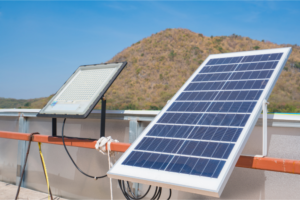
A 12-volt DC solar panel is a photovoltaic module designed primarily for nominal 12V electrical systems. It converts sunlight into direct current (DC) electricity and is commonly paired with 12V batteries, solar charge controllers, DC loads, or small off-grid power systems.
The 12V rating alone does not tell you the panel’s wattage. A 12V panel could be rated at 20W, 50W, 100W, 150W, or another capacity depending on its design.
Does a 12V Solar Panel Actually Produce 12 Volts?
No, a 12-volt DC solar panel does not normally operate at exactly 12V. The 12V figure is a nominal system rating. Its maximum-power voltage and open-circuit voltage need to be higher to deliver charging power to a 12V battery through suitable charging electronics.
For example, a nominal-12V module can have a nominal voltage of 12V, but its voltage at maximum power (Vmp) can be 20V, and its open-circuit voltage (Voc) can be 22.50V
How Does a 12-Volt Solar Panel Work?
A 12V solar panel works by converting sunlight directly into DC electricity through photovoltaic cells. The electrical output can then power a compatible DC load or pass through a charge controller to recharge a battery.
Here is how the process works:
- Sunlight reaches the solar cells: Photons transfer energy to electrons inside the photovoltaic material.
- The cells generate DC electricity: The movement of these electrons creates electrical current.
- Connected cells provide usable voltage and current: The cell arrangement determines the panel’s electrical characteristics.
- A charge controller regulates battery charging: When a battery is in use, a compatible controller manages the current delivered to it.
- The battery stores energy: Stored solar electricity can supply power to loads when sunlight is low or absent.
- An inverter can supply AC loads: If the connected device requires AC (alternating current) rather than DC, a suitable inverter converts battery DC into AC.
Solar output changes with irradiance, shade, temperature, dust, and panel orientation. The wattage printed on a panel represents rated output under specified test conditions, not guaranteed output throughout the day.
What are the Different Types of 12V Solar Panels?
12-volt PV panels are available in different cell technologies and physical designs, including monocrystalline, polycrystalline, flexible, and foldable modules. The right type depends on space, portability, durability, and the amount of power required.
Common options include:
- Monocrystalline 12V solar panels: These use monocrystalline silicon cells and are available in low-wattage modules for battery charging, lighting, and off-grid uses. Mono PERC (Monocrystalline Passivated Emitter and Rear Cell) versions are also currently sold in India, but they have higher wattages of 550- 540 Wp (watt-peak) and are commonly used for rooftop solar systems.
- Polycrystalline 12V solar panels: Polycrystalline technology is no longer common in new high-wattage rooftop systems. However, 12V polycrystalline modules are available in smaller capacities such as 20W, 40W, 50W, 75W, and 100W.
- Flexible 12V solar panels: Flexible PV panels feature a lightweight, bendable construction and suit curved surfaces on boats, vans, RVs, and similar mobile installations.
- Portable/foldable 12V solar panels: These portable solar modules fold for transport and can be deployed temporarily during camping or other off-grid activities. Portable kits may also include a charge controller.
12V Solar Panel Specifications Explained
12V solar panel specifications tell you far more than the 12V label alone. Wattage, Vmp, Voc, Imp, Isc, and efficiency determine how the module will actually perform and whether it is compatible with your controller and battery setup.
The table below uses an actual manufacturer’s technical datasheet for a 100W nominal-12V mono-PERC module.
| Specification | Example Specification | Explanation |
| Rated wattage | 100W | The maximum rated panel power under Standard Test Conditions (STC) |
| Nominal voltage | 12V | This identifies the system voltage class. It is not the panel’s exact operating voltage. |
| Vmp | 20V | Voltage at which the panel delivers its rated maximum power under STC. |
| Voc | 22.50V | Open-circuit voltage when the panel is illuminated but no load is connected. |
| Imp | 5A | Current at the panel’s maximum power point. |
| Isc | 5.30A | Short-circuit current under specified test conditions. |
Please note: These values are an example of how a real 12-volt DC solar panel can be specified. Actual 12V solar panel specifications can change significantly with panel wattage, dimensions, solar cell technology, cell configuration, construction, temperature, irradiance, manufacturing design, and model. Always use the datasheet supplied with the exact panel you are buying for exact specifications.
What are the Components of a 12V Solar Power System?
A 12V solar power system usually combines the panel with charging, storage, wiring, and optional conversion equipment. The exact components depend on whether the system only powers a DC load or also stores electricity in a battery.
The main components are:
- Solar panel: Generates DC electricity from solar radiation.
- 12-volt solar charge controller: Regulates the electricity used to charge a compatible battery.
- Battery: Stores energy for use when solar generation is low or unavailable.
- Wiring and protection: Correct cable sizes, connectors, fuses, and other protection devices carry current safely between components.
- Inverter, if required: Converts battery DC to AC when the load requires alternating current. It is unnecessary for compatible 12V DC loads.
How Much Power Does a 12V Solar Panel Produce?
A 12V solar panel can produce very different amounts of power depending on its wattage and current rating. The 12V label does not determine its wattage.
Electrical power can be calculated using a simple formula listed below:
| Power (W) = Voltage (V) × Current (A) |
For example, if a 12V panel has a maximum-power voltage (Vmp) of 20V and a maximum-power current (Imp) of 5A, then the power it delivers is 100W (20V Vmp × 5A Imp).
How Many Amps Does a 12V Solar Panel Produce?
The current produced by a 12V solar panel depends on its power rating (wattage) and maximum power voltage (Vmp). A higher-wattage panel will produce more current than a lower-wattage panel operating at a similar voltage.
You can estimate the current using the formula listed below:
| Current (A) = Power (W) ÷ Voltage (V) |
For example, if a 100W 12V solar panel has a Vmp of 20V, then 100W ÷ 20V = 5A.
So, the panel produces about 5A at its maximum power point.
The exact current should always be checked in the panel’s datasheet under Imp, or current at maximum power. Do not calculate it by simply dividing the wattage by the nominal 12V rating because the panel’s actual operating voltage is usually higher.
The panel current and the battery-charging current can also differ. An MPPT (maximum power point tracking) charge controller can convert the panel’s higher voltage into a lower charging voltage while increasing the available charging current.
How Much Energy Can It Generate Per Day?
The daily energy generated by a 12V solar panel depends mainly on its wattage, available sunlight, and real-world system losses. The 12V rating itself does not determine how much electricity the panel generates in a day.
A simple estimate can be made using the formula listed below:
| Daily energy = Panel wattage × Peak sun hours × System efficiency |
For example, assume the location receives 5 peak sun hours per day, and the system delivers about 80% of the panel’s theoretical output after real-world losses.
The approximate daily generation would be:
| Panel Wattage | Illustrative Daily Energy* |
| 50W | ~200Wh (50W × 5 hours × 80%) |
| 100W | ~400Wh (100W × 5 hours × 80%) |
| 150W | ~600Wh (150W × 5 hours × 80%) |
| 200W | ~800Wh (200W × 5 hours × 80%) |
*Please note: These figures are only indicative. Actual generation varies with location, season, cloud cover, temperature, shade, dust, panel angle, controller efficiency, and battery charging losses.
Can a 12V Solar Panel Charge a 12V Battery?
Yes, a 12-volt DC solar panel can charge a compatible 12V battery, but it should normally do so through a suitable charge controller. The controller ensures that the voltage and current supplied to the battery match its charging requirements.
Battery chemistry also matters. Lead-acid, lithium-ion, LiFePO4 (Lithium Iron Phosphate), and other batteries can have different charging voltages, current limits, and protection requirements.
What Size Solar Panel Do You Need for a 12V Battery?
Panel size depends on the battery’s Ah capacity, how much energy needs to be replaced, available sunlight, and charging losses.
A useful estimate is: Panel wattage = Energy to be replaced ÷ (Peak-sun-hours × System efficiency).
Suppose you want to replace 50% of a 12V battery’s nominal energy in one day, with 5 peak-sun-hours and 80% overall efficiency.
| 12V Battery | Energy to Replace | Approximate Panel Size* |
| 50Ah | 300Wh | 75W |
| 100Ah | 600Wh | 150W |
| 150Ah | 900Wh | 225W |
| 200Ah | 1,200Wh | 300W |
*Please note: These are planning examples, not universal battery recommendations. Actual sizing must consider battery chemistry, permitted charging current, controller limits, depth of discharge, and local sunlight.
How Long Does It Take to Charge a 12V Battery?
Charging time depends on how much energy must be replaced and how much charging power actually reaches the battery.
Use this formula: Charging time ≈ Energy to replace ÷ Effective charging power.
Take a 12 V, 100 Ah battery with 600 Wh that needs to be replaced.
With a 150W panel and an assumed 80% effective charging power:
- Effective power = 150W × 80% = 120W
- Charging time = 600Wh ÷ 120W = ~5 peak-sun-hours
A 100W panel under the same assumptions would need about 7.5 peak-sun-hours, so it may take more than one day if only around five equivalent peak-sun-hours are available.
Do You Need a 12-Volt Solar Charge Controller?
Yes, a compatible solar charge controller is generally required when a 12V panel charges a rechargeable solar battery. It regulates charging and prevents the panel from simply feeding changing solar voltage directly into the battery.
A controller performs several important functions:
- Controls charging voltage and current: It keeps battery charging within the controller’s programmed limits.
- Matches the charging setup to the battery: Battery chemistry and voltage must be supported by the controller.
- PWM (pulse width modulation) vs MPPT (maximum power point tracking): PWM controllers are simpler, while MPPT controllers can convert excess panel voltage into useful charging current and usually offer greater flexibility.
- Controller amperage: The controller must handle the expected charging current and remain within its specified PV input voltage, current, and wattage limits.
However, a solar charge controller is not required for every direct DC load. It is required for sensitive electronics that may still require voltage regulation, as raw solar output varies throughout the day.
What is the 12-Volt Solar Panel Price in India in 2026?
The 12-volt solar panel price in India in 2026 ranges between ~₹1,200* and ~₹7,500* for rigid panels between about 20W and 150W, based on current online listings.
*DISCLAIMER (VERY IMPORTANT): These prices are indicative figures based on standard online market research and should not be treated as fixed retail prices. The actual 12V solar panel price in India can vary depending on wattage, output current, dimensions, solar cell technology, panel construction, manufacturing quality, seller, warranty, order quantity, taxes, shipping charges, discounts, and product availability. This range covers standalone 12V panels and excludes imported portable USB chargers, bundled systems, or specialized products, which can cost considerably more. SolarSquare does not manufacture or sell 12-volt PV panels. We install rooftop solar systems using high-efficiency and high-wattage TOPCon (Tunnel Oxide Passivated Contact) and latest technology panels for homes, housing societies, and commercial and industrial properties.
Benefits and Drawbacks of a 12-Volt DC Solar Panel
The main benefit of a 12-volt DC solar panel is its compatibility with small battery-based and DC power systems. Its main limitation is the high current that develops as system power increases, which makes 12V less suitable for larger electrical loads.
Here is a snapshot of all the advantages and disadvantages of 12-volt DC solar panels:
| Advantages of 12-Volt PV Panels | Disadvantages of 12-Volt DC Solar Panels |
| Well suited to compatible 12V batteries and DC loads. | Current becomes high as system wattage increases. |
| Available in small wattages for lighting, charging, and remote equipment. | Higher current can require thicker cables and increase wiring losses. |
| Flexible and foldable formats are available for mobile applications. | Battery charging normally requires a compatible solar charge controller. |
| Can power DC loads without an inverter when voltage requirements match. | They are not a replacement for high-wattage modules used in home rooftop solar systems. |
What are the Applications/Uses of 12-Volt Solar Panels?
12V solar panels are mainly used where electricity demand is relatively small, and the system is based around a 12V battery or DC load. Their compact size and voltage class make them particularly useful in mobile, remote, and standalone applications.
Common applications include:
- 12V battery charging with a compatible controller
- RVs, caravans, and camper vans
- Boats and marine battery systems
- Camping and portable power setups
- Solar street lights and standalone lighting
- Remote monitoring and telemetry equipment
- Telecommunications and other remote equipment
- Small DC fans, LEDs, and electronic loads
Many tier-1 manufacturers of 12V off-grid modules specifically list RVs, remote equipment, monitoring systems, pumping, and battery charging among their intended uses.
12V vs 24V vs 48V Solar System: Which Should You Choose?
Choose 12V for small, portable systems, 24V when power requirements increase, and 48V for larger battery and inverter systems. Increasing system voltage reduces the current required to carry the same amount of power.
The relationship is: Current = Power ÷ Voltage
For an ideal 1,000W DC load before losses:
- At 12V, current is about 83A.
- At 24V, current is about 42A.
- At 48V, current is about 21A.
This is why higher-voltage battery systems become more practical as power requirements increase.
Here’s a side-by-side comparison of all three types:
| Factor | 12V System | 24V System | 48V System |
| Best for | Small loads and mobile systems | Medium-power systems | Larger battery and inverter systems |
| Current for same power | Highest | Lower | Lowest |
| Cable requirements | Increase quickly with power | More manageable | Better suited to high power |
| Common use | Camping, boats, RVs, lighting, small batteries | Larger off-grid loads | Large off-grid or battery-backed systems |
How to Choose the Right 12V Solar Panel?
The right 12-volt DC solar panel should be selected around the load or battery it needs to serve, rather than choosing a panel simply because its label says 12V.
Before buying, check:
- Required wattage: Calculate the energy your load consumes or the energy that must be returned to the battery.
- Vmp (voltage at maximum power) and Voc (open-circuit voltage): Check both against the controller’s permitted solar input range.
- Imp (current at maximum power) and Isc (short-circuit current): Make sure wiring, connectors, and controller current limits are suitable.
- Battery compatibility: Match the charging system with battery voltage, chemistry, Ah capacity, and charging current limits.
- Charge controller: Confirm whether PWM or MPPT is appropriate and check its PV (photovoltaic) input specifications.
- Physical design: Choose rigid, flexible, or foldable construction according to where the panel will be used.
- Weather exposure: Check junction-box protection, construction, and mounting requirements for outdoor use.
- Datasheet: Always compare the exact manufacturer’s electrical specifications before connecting a panel to batteries or sensitive equipment.
Conclusion
A 12V solar panel makes sense when the electricity requirement itself is small, such as charging a 12V battery or powering portable, mobile, or remote DC equipment. As power requirements increase, however, scaling a 12V system becomes less practical because the higher current demands thicker wiring and more carefully sized equipment.
If your goal is to reduce the electricity bill of a home, housing society, or business, a small 12-volt DC solar panel is not the right solution. SolarSquare designs and installs complete rooftop solar systems using high-wattage solar panels. You can book a free solar consultation to understand the right system capacity for your property and expected savings.
Frequently Asked Questions
What appliances can a 12V solar panel run?
A 12V solar panel can support compatible small DC loads such as LEDs, DC fans, mobile charging, routers, cameras, and other low-power electronics when the panel has sufficient wattage.
Can a 12-volt DC solar panel power an entire home?
No. The low-wattage 12V panels are designed for battery charging, DC bulbs, small off-grid loads, and portable or remote applications. Modern home rooftop solar systems use much higher-wattage modules connected into arrays designed around a suitable solar inverter.
Can I connect a 12V solar panel directly to a battery?
You should generally use a compatible charge controller between the panel and a rechargeable battery. A nominal 12V panel can have a Vmp around 18V to 20V or higher, and battery charging requires controlled voltage and current rather than raw panel output.
Can I use a 24V solar panel with a 12V battery?
Yes, it can be possible with a suitable MPPT charge controller that accepts the panel’s Voc and converts its output to the charging requirements of the 12V battery.
Is a 100W solar panel enough for a 12V battery?
It depends on the battery capacity, how deeply it is discharged, available sunlight, and charging losses. For example, a 100W panel receiving 5 peak sun hours with 80% overall efficiency can generate about 400Wh per day. Whether that is enough depends on how much energy the battery needs to recover.
How many 12V solar panels can I connect together?
The limit depends on the charge controller’s maximum PV voltage, current, and wattage, along with how the panels are connected. Series connections increase voltage, while parallel connections increase current. Always stay within the exact equipment ratings.
What can I power with a 100W 12V solar panel in India?
Through a correctly sized controller and battery, a 100W 12V panel can support combinations of LEDs, small DC fans, phones, routers, or similar low-power devices.